Okuninushi (Okuninushi-no-Kami) is the **god of nation-building (kunizukuri)** in Japanese mythology, the foremost "earthly god" (kunitsukami) who cultivated and ruled the terrestrial world, the Central Land of Reed Plains (Ashihara-no-Nakatsukuni). Counted as a descendant of Susanoo, he is best known as the protagonist of the "Transfer of the Land" (Kuniyuzuri), in which—after enduring many trials and ordering the land—he ceded his realm to the heavenly gods. As the chief deity of **Izumo Taisha** (the Grand Shrine of Izumo) in Shimane Prefecture, he is widely revered as a god of marriage, healing, and agriculture.
Mythology
The White Hare of Inaba
In his youth, Okuninushi went by the name Onamuji. When his many brother deities, the Yasogami (the "eighty gods"), set off to court the beautiful princess Yakami-hime of Inaba, he trailed behind as their baggage-carrier. Along the way he came upon a hare that lay suffering, its skin flayed away. The Yasogami maliciously taught the hare a false remedy that only made it suffer more, but Onamuji gave it the correct cure—to wash itself in fresh water and roll in the pollen of the cattail (gama) reed—and so saved it. The healed hare prophesied, "It is you, not your brothers, whom Yakami-hime will marry," and so it came to pass. Beloved to this day, the tale embodies Okuninushi's character: one who opens the way through kindness and wisdom.
The Trials in the Land of the Roots
Having won the princess, Onamuji drew the resentment of the Yasogami, who killed him twice, only for him to be revived each time with the aid of his mother goddess and other deities. Escaping their malice, he made his way to the Ne-no-Katasukuni (the Land of the Roots), where Susanoo dwelt, and there fell in love with Susanoo's daughter Suseribime. Susanoo set him brutal trials—making him sleep in chambers full of snakes and wasps, and setting fire to a field around him—but with his wife's help he overcame them all. At last, taking Susanoo's treasures (the Sword of Life, the Bow and Arrows of Life, and the heavenly speaking koto) and fleeing with Suseribime, he heard Susanoo bestow upon him a new name: "With that sword and those bow and arrows, subdue your brothers, become Okuninushi (Great Lord of the Land), and rule the land." Thus Susanoo acknowledged him as his heir.
Building the Land with Sukunabikona
Okuninushi joined forces with Sukunabikona, a tiny god who came from beyond the sea, and together they cultivated the terrestrial world (the Central Land of Reed Plains), establishing the arts of agriculture, healing, and sorcery to lay the foundations of human life. After Sukunabikona departed for Tokoyo-no-Kuni (the Eternal Land), Okuninushi is said to have completed the building of the land by enshrining Omononushi—who appeared illuminating the sea—on Mount Miwa in Yamato. Through these deeds, Okuninushi came to be regarded as the god who governs healing, agriculture, and the governance of the land.
The Transfer of the Land
When the land had been brought to rich order, Amaterasu of Takamagahara declared that "the Central Land of Reed Plains is a realm that my descendants should rule," and sent envoys to press Okuninushi to surrender it (the Transfer of the Land). Okuninushi withheld an immediate answer and entrusted the decision to his son Kotoshironushi. Kotoshironushi consented, but another son, Takeminakata, resisted; he contended in a trial of strength with the envoy Takemikazuchi, was defeated, and withdrew to Suwa in Shinano. In the end, Okuninushi ceded the land on the condition that a grand palace towering to the heavens be built for him (said to be the origin of Izumo Taisha), and he himself became a god presiding over the unseen world (kakuriyo).
Symbolism & character
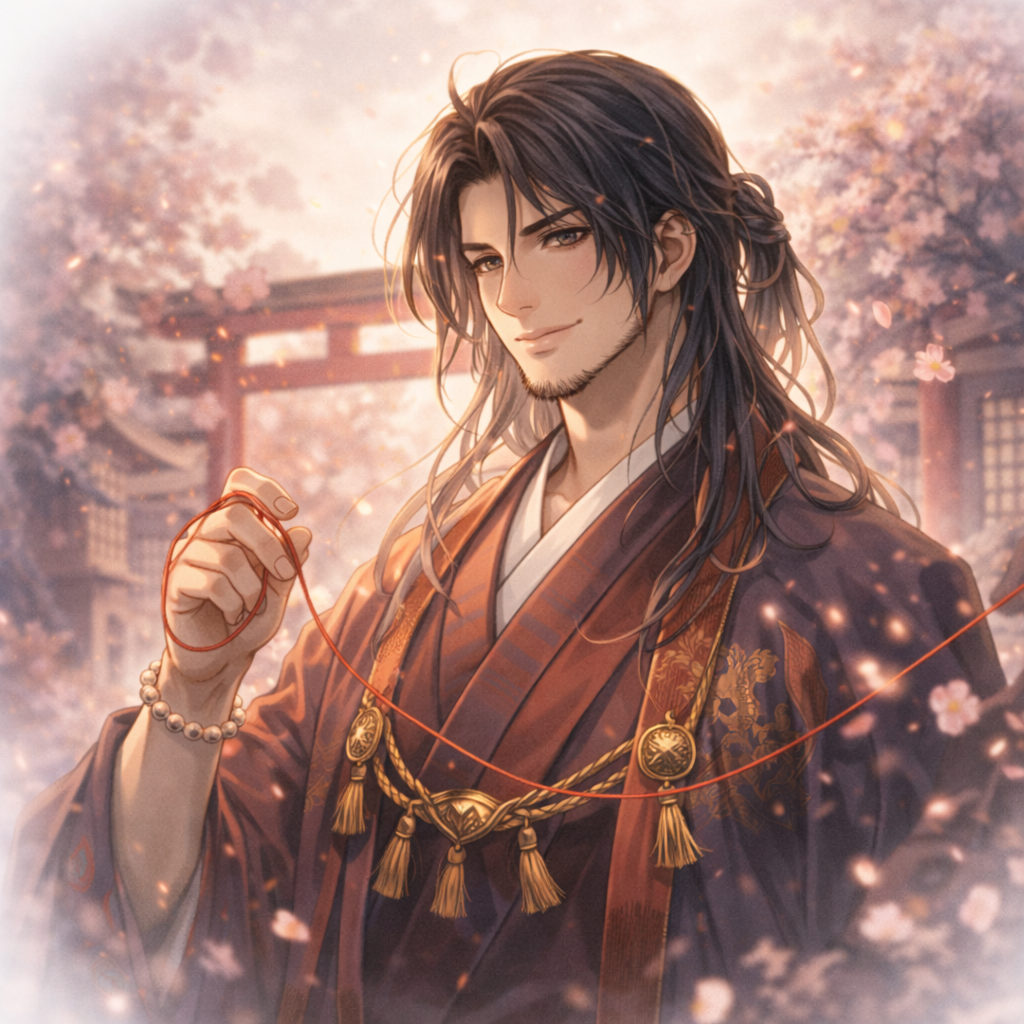
Okuninushi embodies "binding" and "acceptance." Rather than forcing his way through by raw power, he saves the suffering hare, overcomes his trials with the help of his wife and those around him, and entrusts decisions to his sons—a gentle ruler who accomplishes things through relationships. The fecundity attributed to him, with his many wives and one hundred and eighty-one children, developed into his role as a god of "marriage" who weaves the world together by binding person to person and land to land. Moreover, having built a land from nothing, he relinquishes it gracefully when asked and withdraws to become the guardian of the unseen world—and it is this cycle of "building, then letting go" that lies at the heart of Okuninushi. In later ages he was syncretized with the god of fortune Daikokuten, and was depicted as an approachable bringer of good fortune holding a rice bale and a magic mallet.
Shrines & worship
His head shrine is Izumo Taisha in Shimane Prefecture. Traced to the grand palace built at the time of the Transfer of the Land, it draws fervent devotion from across the country as the "god of marriage." In the tenth lunar month—called Kannazuki, the "month without gods"—the deities of all Japan are said to gather in Izumo, so that the Izumo region instead calls this month Kamiarizuki, the "month with gods." The shrine is also known for its distinctive form of worship: "two bows, four claps, one bow." Beyond Izumo, he is widely enshrined as a god of nation-building, marriage, and healing: as Omononushi at Omiwa Shrine in Nara, at Okunitama Shrine (the head shrine of Musashi Province, in Tokyo), and at Keta Taisha in Ishikawa, among many others.
FAQ
Q. What is Okuninushi the god of?
He is the god of nation-building who cultivated and ruled the terrestrial world (the Central Land of Reed Plains), and the foremost of the "earthly gods." He is especially known as a god of marriage, as well as a god of healing, agriculture, and the governance of the land.
Q. Where is Okuninushi enshrined?
Izumo Taisha in Shimane Prefecture is his head shrine. He is also enshrined at many places across Japan, including Omiwa Shrine in Nara, Okunitama Shrine in Tokyo, and Keta Taisha in Ishikawa.
Q. What is the relationship between Okuninushi and Susanoo?
In the Kojiki, Okuninushi is a sixth-generation descendant of Susanoo; in the Land of the Roots he overcame Susanoo's trials, was united with Susanoo's daughter Suseribime, and received the name "Okuninushi" along with the mission to rule the land. The main text of the Nihon Shoki, however, also transmits a tradition that he was a son of Susanoo.
Q. What is the "Transfer of the Land"?
It is the myth in which Okuninushi handed over the terrestrial world he had built to the heavenly gods of Takamagahara (the descendants of Amaterasu). His son Kotoshironushi consented, while Takeminakata resisted and was defeated; Okuninushi ceded the land on the condition that a grand palace (the origin of Izumo Taisha) be built, and became a god presiding over the unseen world.
Q. Why is he called the "god of marriage"?
In addition to his fertile divine character, having fathered many wives and children, he came to be revered as a god who binds people together because the deities of all Japan were said to gather in Izumo in the tenth lunar month to confer over the bonds between men and women. In later ages he was also syncretized with the god of fortune Daikokuten.